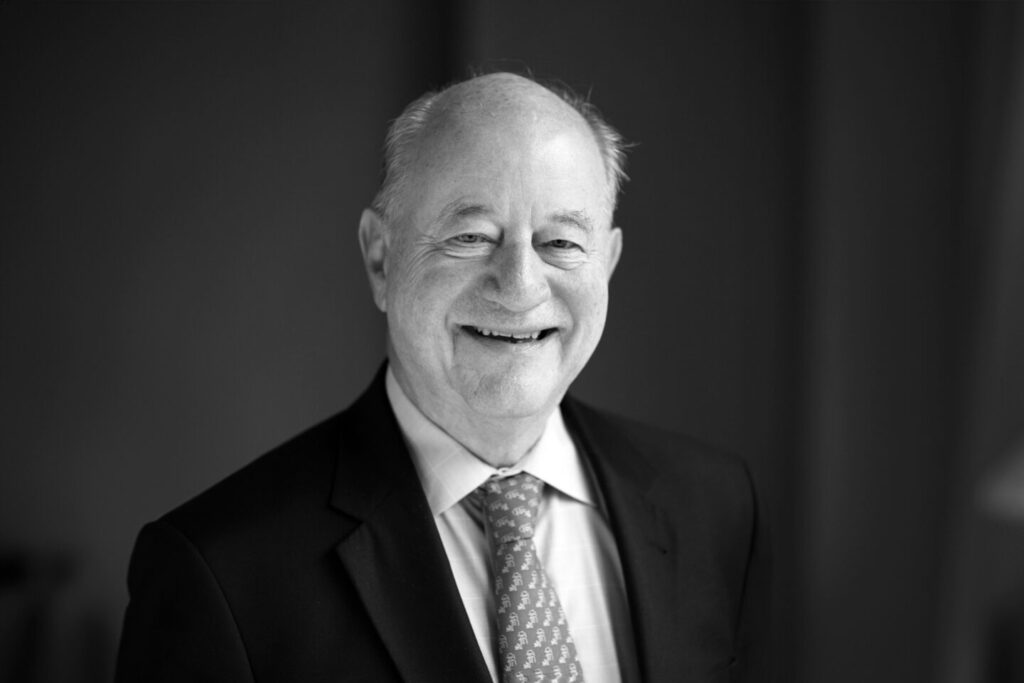
Gerald Fischbach, MD, who served as the Edison Professor of Neurobiology and chair of the WashU Medicine Department of Neuroscience (then the Department of Anatomy and Neurobiology) from 1981 to 1990, died Oct. 25 in Westchester, N.Y. He was 87.
Fischbach pioneered the use of nerve cell cultures to conduct groundbreaking research on the formation of synapses, the junctions where neurons transmit information to one another and to other cells. His work provided important insight into synaptic structure, biochemistry and electrical activity. He was the first to identify the importance of the ARIA protein, generated by muscle cells, in the formation of chemical synapses.
During his tenure as chair, Fischbach helped establish and served as director of the McDonnell Center for Cellular and Molecular Neurobiology. He was also director of the McDonnell Center for Systems Neuroscience.
“Dr. Fischbach has left a substantial legacy — the McDonnell Centers have had a profound impact at WashU, providing stable funding support, which has driven discovery and innovation and established WashU Medicine as an international neuroscience powerhouse,” said Linda J. Richards, PhD, chair of the Department of Neuroscience, Edison Professor of Neuroscience, and Director of the McDonnell Center for Cellular and Molecular Neurobiology.
After his leadership role at WashU Medicine, Fischbach was chair of the neurobiology departments at both Harvard Medical School and Massachusetts General Hospital from 1991 to 1998; director of the National Institute of Neurological Disorders and Stroke, part of the National Institutes of Health (NIH), from 1998 to 2001; and executive vice president for health and biomedical sciences and dean of the faculty of medicine for the College of Physicians and Surgeons at Columbia University from 2001 to 2006.
In 2006, he became the founding director of the Simons Foundation Autism Research Initiative, leading efforts to develop resources and coordinate research to better understand the biology of autism. He remained in the role until 2013, when he became the foundation’s first chief scientist.
Fischbach graduated magna cum laude with a bachelor’s degree in mathematics and chemistry from Colgate University in Hamilton, N.Y., in 1960. He received his MD from Weill Cornell Medicine in 1965 and completed his internship at the University of Washington Hospital in Seattle the following year.
After his internship, Fischbach worked at both the National Institute of Neurological Disorders and Stroke and the National Institute of Child Health within the NIH, where he began his life’s work researching the synapse. In 1973, he joined Harvard Medical School’s Department of Pharmacology, where he was a faculty member until coming to WashU Medicine in 1981.
Fischbach was recognized throughout his career for his scientific accomplishments and leadership, including serving as president of the Society for Neuroscience from 1983 to 1984. He was an elected member of the National Academy of Sciences, the American Academy of Arts and Sciences, the National Academy of Medicine and the American Philosophical Society.
He is survived by his wife, Ruth Fischbach, PhD; four children, Elissa Grayer, Peter Fischbach, MD, Neal Fischbach, MD, and Mark Fischbach; and 12 grandchildren.
Read more here.