When Heather Garrett, MD, sees a good idea, she wastes no time in pursuing it. Four years ago, a colleague suggested that Garrett, an associate professor at WashU Medicine Mallinckrodt Institute of Radiology, look into a new procedure called cryoablation to treat breast cancer.
Cryoablation kills tumor tissue by freezing it. The procedure is a minimally invasive alternative to lumpectomy, a surgical removal of early-stage breast cancer tumors.
Garrett ran with the idea. She has since made Siteman Cancer Center, based at Barnes-Jewish Hospital and WashU Medicine, a high-volume treatment center that draws patients from around the region for breast cryoablation, and Garrett is now one of the country’s busiest practitioners, performing almost 50 procedures a year.
“We have some patients who cannot tolerate surgery due to underlying physical reasons, or they can’t tolerate the anesthesia or sometimes they have extreme anxiety about the operation,” said Garrett. “Those patients could only get radiation or chemotherapy. But we know that individuals who don’t have surgery for their cancer have worse outcomes. Cryoablation is a fantastic option for these cases.”
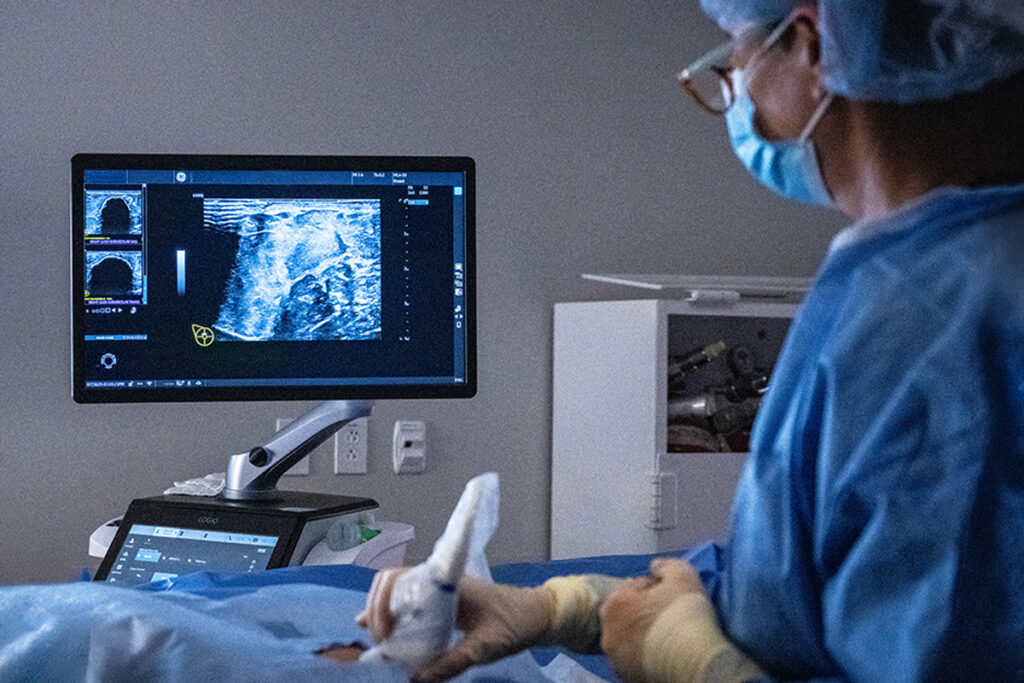
During cryoablation, the patient is awake and needs only local anesthesia, whereas lumpectomies normally require general anesthetic. A radiologist uses ultrasound imaging to insert a thin probe through the skin and then guide it to the tumor mass to freeze it with extremely low temperatures. The tumor tissue dies and is reabsorbed by the body.
Until recently, breast cryoablation had mainly been used for patients who, because of medical history or underlying health conditions, aren’t considered good candidates for surgery. The FDA has since broadened its use, approving cryoablation for older women with low-risk, early-stage breast cancers as an alternative to surgery. Lumpectomies remain the standard of care for early-stage and localized breast cancers, with decades of verified results for clinicians to rely on.
Garrett realized that more data were needed before clinicians and patients could make fully informed choices between the two procedures.
I really see breast cryoablation as part of the general movement toward the de-escalation of breast cancer care — doing less while being just as effective.
Heather Garrett, MD
To provide that data, Garrett is now leading two separate clinical trials. The first, appropriately called COOL-IT-PRO, is a multicenter trial tracking long-term outcomes among patients who received cryoablation for breast cancer. This study includes patients of all ages and with cancers of varying severity.
The second — COOL-IT — is more narrowly focused and is the first U.S. phase III trial on cryoablation for breast cancer. This study is co-led by Garrett and Julie Margenthaler, MD, a professor of surgery and the director of Breast Surgical Services at Siteman Cancer Center. The study is a randomized trial that aims to recruit 120 women ages 50 and older with early-stage breast cancer who are selected at random to receive either a standard lumpectomy or cryoablation at Siteman, with long-term follow-up for five years after their procedure.
“The way to ensure overall patient safety and the best long-term outcomes is to get high-quality evidence to guide how clinicians recommend newer procedures like cryoablation,” Garrett said. “As an academic medical center, this is what we can do better than anyone.”
A diagnosis becomes an opportunity to help others
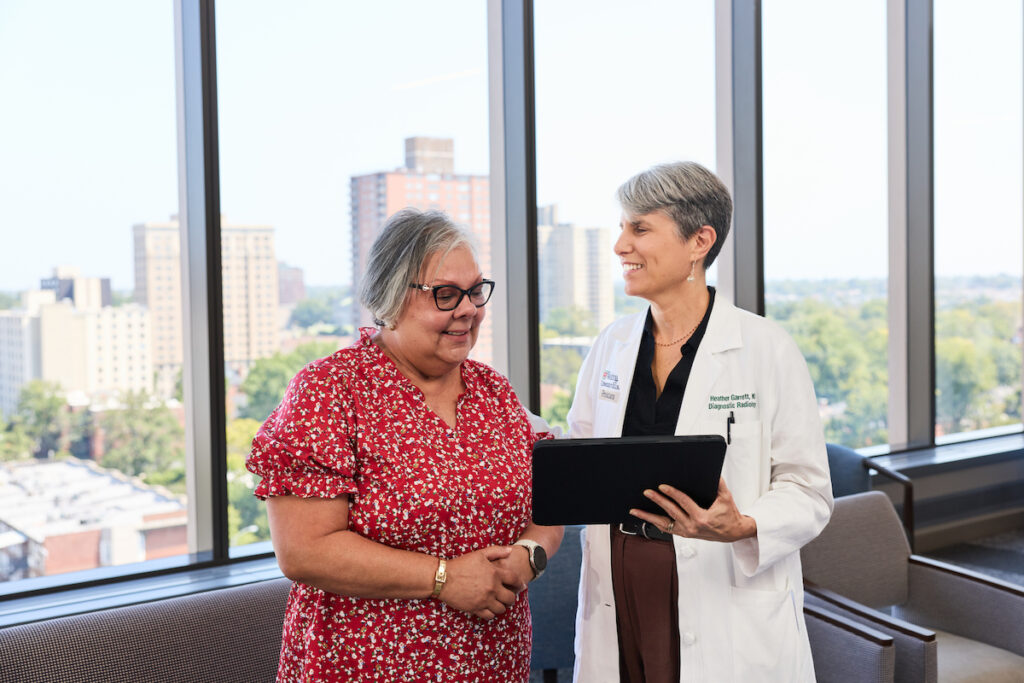
While Garrett was growing the breast cryoablation service line at Siteman and establishing her clinical trials, Leslie Hernandez, now 63, was building her catering business in St. Louis. The company — Mama Pacha Sabor — was named for Hernandez’s mother, who died from breast cancer in 2007. Hernandez had been trying to ramp up the business, which sells homemade Puerto Rican cuisine, in order to raise money to buy computer tablets for low-income families that were struggling with pandemic-era lockdowns.
By 2024, with the lockdowns over, she was pursuing the business full time. The hectic demands of a new and growing enterprise led Hernandez to miss the annual mammogram she’d had faithfully since her mother’s death.
She scheduled another for January 2025 — at the same time Garrett was beginning to recruit patients for her COOL-IT clinical trial. That scan showed a lump. After subsequent scans and a biopsy, Garrett informed her that it was stage 1 breast cancer. Because it had not spread, Garrett asked Hernandez if she would be interested in participating in the trial.
For Hernandez, the answer was easy.
“I discussed it with my husband and children, so it was a family decision, but this was something I wanted — if this is something that I can be part of and also help others, then it’s very important to do,” she said.
Hernandez arrived at Siteman for her procedure on a February morning in 2025. Using ultrasound imaging, Garrett guided the cryoprobe to the tumor. After a 10-minute freeze, an eight-minute break and another 10-minute freeze, the procedure was done.
Hernandez was in and out in 90 minutes and able to drive herself home. She was back to work the next day and, like most patients who undergo the procedure, had minimal scarring or side effects. It can take some patients several days to recover from a lumpectomy, and the surgery often leaves visible scarring or deformations of the affected breast.
This reduced impact on the patient is in keeping with where cancer care and medicine overall have been heading the last few decades, Garrett noted — that is, toward increasingly personalized, targeted and minimally invasive care.
“I really see breast cryoablation as part of the general movement toward the de-escalation of breast cancer care — doing less while being just as effective,” she said. “It adds to the arsenal of tools that we have to treat breast cancer.”
Women in the Hispanic and Latino community tend to be diagnosed with breast cancer at somewhat older ages than national averages, often when their cancers are more advanced. Hernandez, who was already a champion for health and self-care in her community, has been sharing the story of her experience to encourage diligent preventive screenings.
“In the Hispanic and Latino community, we often put our self-care to the side, so I have been telling people about my experience at Siteman,” said Hernandez, who points to her own excellent post-treatment health as evidence of the outstanding care she received. “I went through everything with my health and my business, and I’m now the happiest lady in the world.”
Learn more about breast cancer treatment options at Siteman Cancer Center.