This excerpt is adapted from an article by Diane Toroian Keaggy and Sara Gelrud.
Heather Hageman, the director of collaboration for interprofessional education and community engagement hub at WashU Medicine, said there is a reason why healthcare professionals vote at a lower rate than the general population: access. That’s why she partnered with the Gephardt Institute to establish a polling place at WashU Medicine.
“It can be difficult to get the polls when you are working a 12-hour shift,” said Hageman, director of collaboration for interprofessional education and community engagement hub. “It was my dream for people who live in the city to come down from their shift and be able to vote. It took two solid years of hard work, but the Gephardt team made it happen.”
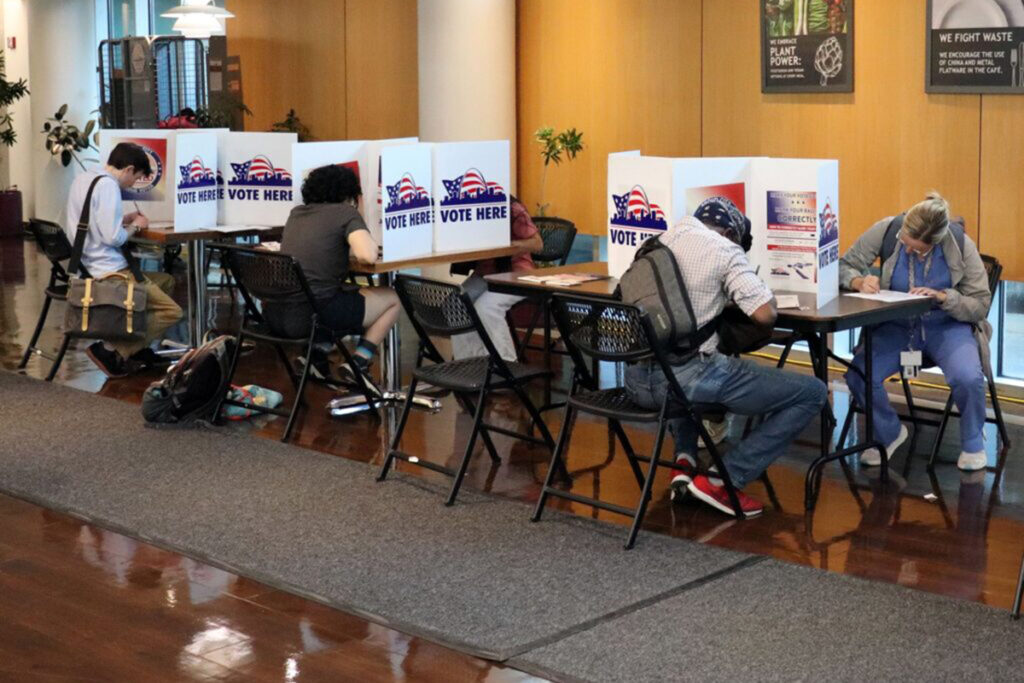
Hageman and some of her students are preparing to welcome hundreds of voters — WashU Medicine students and employees, patients, neighbors and any registered voter who lives in the city — to the Shell Cafe in the McDonnell Medical Sciences Building on Election Day. As one of the site’s official poll managers, Hageman checks in voters, answers questions and makes sure that everyone who is eligible has the opportunity to vote.
“Our first election was in November 2024, and there was torrential rain, so we didn’t have a ton of people. But the people who did come were so thankful,” Hageman recalled. Despite the rain, 496 voters cast their ballots on the WashU Medical Campus that day.
Hageman also serves as the adviser to the Health Professional Student Leadership Council and supports their partnership with Vot-ER, a nonprofit organization working to integrate civic engagement into medical training. The group recently held voter registration drives at Ellen S. Clark Hope Plaza on the Medical Campus and at the SPOT Youth Center. The students answer basic questions, such as who can vote where, and explain more complex phenomena, such as the correlation between voting rates and human health.
“Where there are lower voting rates, there are more hardships for people,” Hageman said. “The American Medical Association and other health organizations recognize voting as a critical social determinant of health. It can shape policies, resource allocation and community well-being.”
Learn more about efforts across WashU to positively impact voting in mid-term elections and beyond.