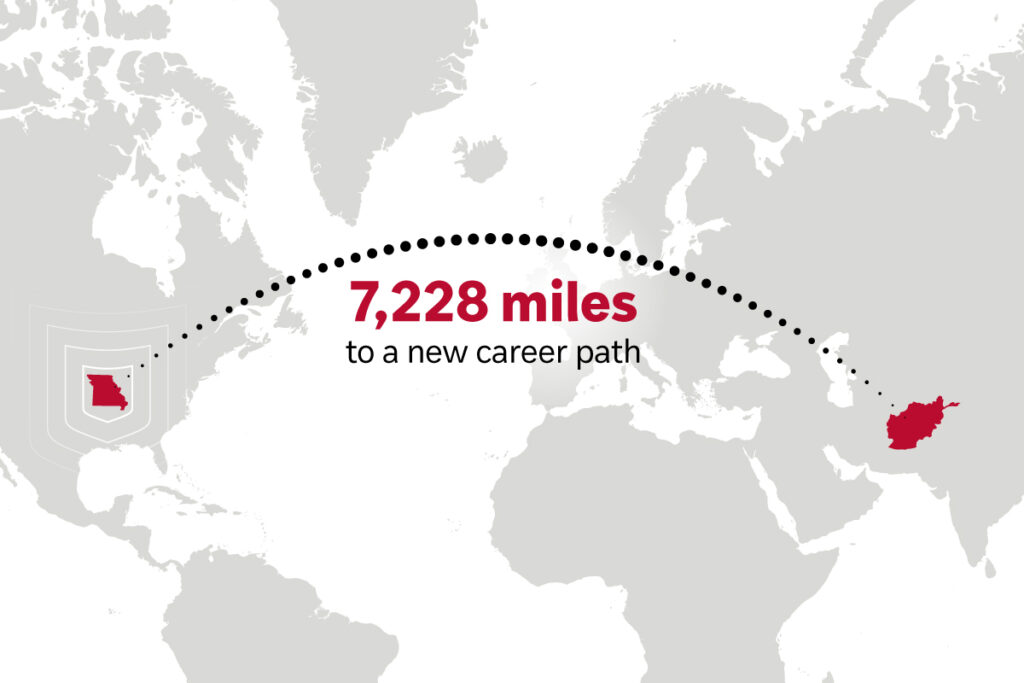
Farahnaz Tooryalai’s career journey began 7,228 miles away.
“I came from a country where war disrupted every part of life, where women and girls were denied basic rights and their voices and dreams were often silenced,” Tooryalai said. “When I left my home country, I packed an entire life in my suitcase: a suitcase of dreams, hopes and ambitions.”
Having family in the St. Louis area, she and her husband made the decision to move here from Afghanistan in the fall of 2022. “I was excited to come to America, but also nervous. I was starting a new chapter in a different country and a new way of life,” she said.
While acclimating to a new culture and language, Tooryalai also endured two months with no job and little direction. Just as she began working toward a GED, an apartment fire destroyed everything the couple owned. The stress of the event contributed to a heartbreaking miscarriage.
Through it all, she never lost sight of her goal of obtaining an education. Having been a midwife in Afghanistan, she also was eager to find her way back into healthcare.
“There were moments when I felt it was impossible to continue,” Tooryalai said. “But I made a choice to keep going, not only for myself, but for those who are still waiting for the opportunity to learn, grow and dream.”
From the ashes, new doors began to open. One of the community college professors who helped her earn her GED suggested she apply to the WashU Medical Apprenticeship Program, and Tooryalai was accepted Dec. 16, 2024.
“My teachers believed in me and were impressed with my aptitude,” she said. “Talent and intelligence are abundant all over the world; but opportunity is not. I was so grateful for the chance to advance my career and contribute to the care of others again.”
About the program
Launched in 2018, the WashU Medical Apprenticeship Program is designed to spur interest in the medical field and fill crucial positions. Typically, medical assistants are trained by trade schools and must pay their own tuition. That, matched with the intensity of the curriculum, makes it difficult for students to go to school and work at the same time.
The program has grown to impact the careers — and lives — of 437 people and counting.
Tuition for those chosen for WashU’s 16-week program is covered by grants from the city of St. Louis, St. Louis County, the state of Missouri and the federal government. Training consists of classwork four hours a week and hands-on skills building 36 hours a week in various locations where WashU Medicine clinicians deliver care. Medical assistants support clinical departments through tasks such as taking patients’ vital signs, drawing blood and administering vaccines.
They also schedule appointments, help complete insurance forms and coordinate laboratory services, among other duties. In exchange, apprentices receive an hourly wage and are considered full-time, benefits-eligible WashU employees beginning on day one. Following successful completion of their classroom learning and final exam, graduates earn a Certified Clinical Medical Assistant credential.
The program has grown to impact the careers — and lives — of 437 people and counting.
“Our program provides the pathway needed to follow a dream, to grow professionally and personally, and to build a career that individuals can be proud of,” said Kathy Clark, director of medical apprenticeships in WashU’s Office of Human Resources. “Hearing inspiring stories like Farah’s reminds me of why we do what we do.”
Tooryalai graduated from the program on March 27, 2025.
Fast forward to 2026
She now supports a busy cardiology clinic at the WashU Medicine and Barnes-Jewish Heart and Vascular Center, where she directs patients to their exam rooms, takes their vitals and performs EKGs, verifies their medication history and more. Tooryalai is also enrolled in pre-nursing studies through the WashU Continuing & Professional Studies program, with aspirations toward becoming a nurse.
“Farah has such a vibrant personality,” said her supervisor Jennifer Lusk, the clinic administrator for the center. “She is attentive to her patients’ needs and very responsive to provider requests, too. Farah should be proud of her ongoing effort to grow her career.”
Clark submitted an application to St. Louis City, requesting a proclamation on behalf of WashU in recognition of National Apprenticeship Week. In response, St. Louis Mayor Cara Spencer declared April 26 to May 2 “National Apprenticeship Week” by official proclamation.
WashU Medical Apprenticeship Program
WORK
Support WashU Medicine clinicians 40 hours per week (36 hours during classroom learning weeks).
LEARN
Gain knowledge and skills in the classroom, 4 hours a week for 16 weeks.
EARN
Get paid while obtaining a Certified Clinical Medical Assistant credential.
Apprentices across WashU Medicine
In addition to the John T. Milliken Department of Medicine where Tooryalai works, medical apprentices support many other WashU Medicine departments and programs, including:
- Department of Neurology
- Taylor Family Department of Neurosurgery
- Department of Obstetrics and Gynecology
- Department of Psychiatry
- Mallinckrodt Institute of Radiology
- Mary Culver Department of Surgery
- WashU Medicine Physicians
These opportunities exist across both adult and pediatric practices throughout the greater St. Louis region, including some Illinois locations.
“This program has given me more than an education. It has given me dignity, direction and hope. Because of this opportunity, I’m no longer simply surviving. I’m moving forward.”
Farahnaz Tooryalai
The Medical Apprenticeship Program is available for both new hires from the St. Louis community and current WashU employees seeking a career pathway for growth and advancement within the organization. Learn more about medical apprenticeships and how they support the WashU Medicine community and beyond.