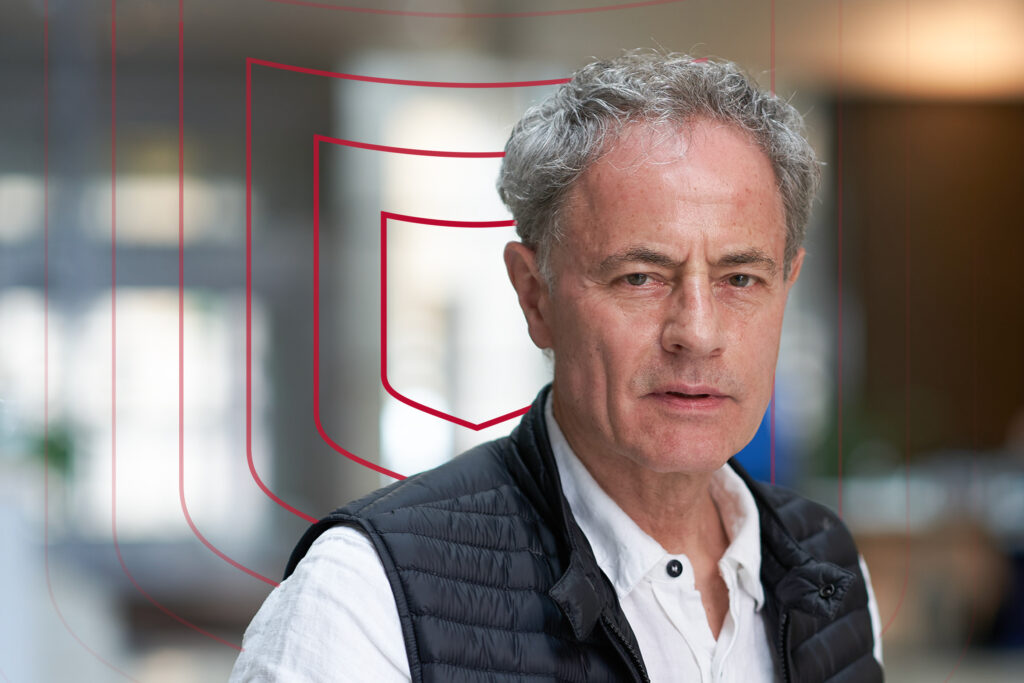
Andreas Burkhalter, PhD, a professor in the Department of Neuroscience at WashU Medicine, has received the 2026 Krieg Cortical Kudos Discoverer Award from the Cajal Club, a scientific research society. The award recognizes scientists whose research has advanced understanding of the cerebral cortex and its connections within the brain.
For more than three decades, Burkhalter has studied how the cortex, the forebrain’s outer layer, processes what we see, sense and use to make decisions. Building on findings by others, including WashU Medicine neuroscientists, he showed that the mouse brain handles information in ascending steps, with each step building on the one before it. The higher steps also send contextual information back down to help the earlier steps interpret what they see.
In a simplified example, when you see a dog, the initial steps in processing the visual information pick out edges and lines; the next step combines those visual elements into shapes; and feedback from context, such as “we’re in a park, so that shape is probably a dog,” helps interpret the shapes as a dog.
Burkhalter also mapped at least nine visual areas in a mouse model. This map now serves as a shared “atlas” that labs worldwide use to describe where activity happens in the brain. It also demonstrates that mice distribute visual information across separate areas and pathways, something once thought to be present only in larger brains.
The Cajal Club will present the award Nov. 15 in Washington, D.C., during Neuroscience 2026, the Society for Neuroscience’s annual meeting.