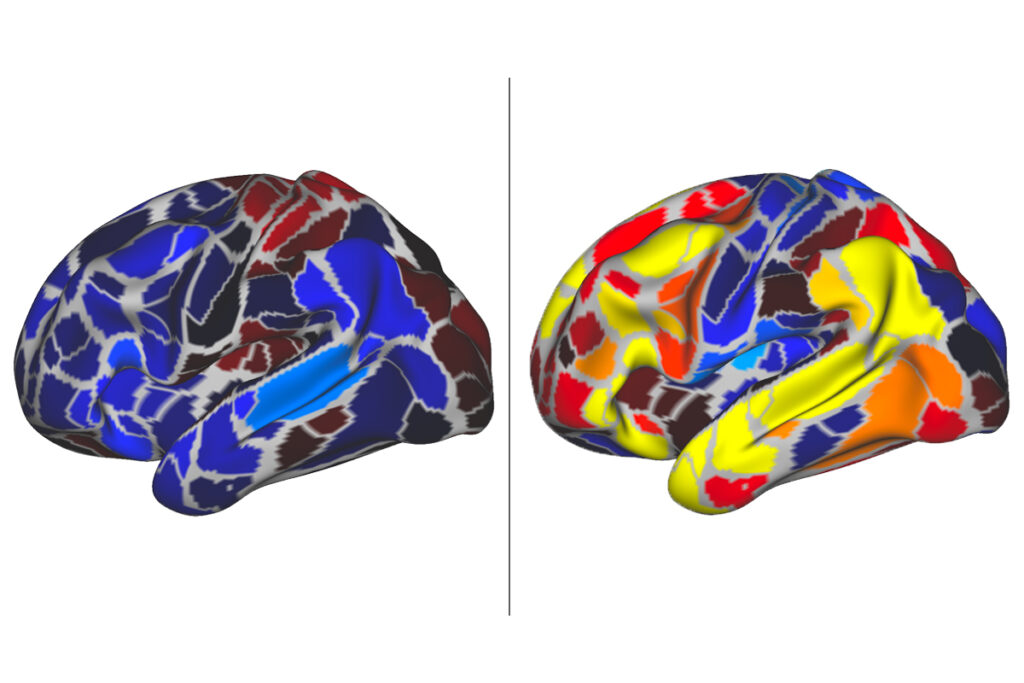
Children with more autistic traits view and experience the world differently than their peers do, and those differences change as the children grow, according to a new study from WashU Medicine published August 12 in the American Journal of Psychiatry.
The study was led by first author Carolyn Lasch, PhD, a postdoctoral researcher in the lab of senior author Chad Sylvester, MD, PhD, a professor in the WashU Medicine Department of Psychiatry. The team studied brain scans from 545 children ages 5 to 15 taken while they watched a 10-minute clip of the animated movie “Despicable Me” inside an MRI machine.
In earlier work analyzing brain scans, the researchers found that as children watched the film, activity across the brain tended to settle into one of three patterns, or “activation states” — one dominated by brain regions that handle sight and movement, one by regions that hold attention steady, and the third by regions that process social and emotional information.
For the current study, the researchers examined the relationship between autistic traits, as reported by the parents, and which brain pattern a child spent the most time in — as well as whether that relationship changed with age or in the presence of other pediatric mental health symptoms. They found that children younger than 9 with more autistic traits spent more time in the sight-and-movement state than did peers with lower levels of autistic traits. But for kids 14 and older, a different pattern emerged: those with more autistic traits spent more time in the social-and-emotional state compared to peers. In every age group, children with more ADHD symptoms, which are common alongside autistic traits, spent less time in the attention state.
Although the differences were small and larger studies are needed to confirm them, the researchers say activation states could eventually help tailor interventions to a child’s age and track whether treatments are working.