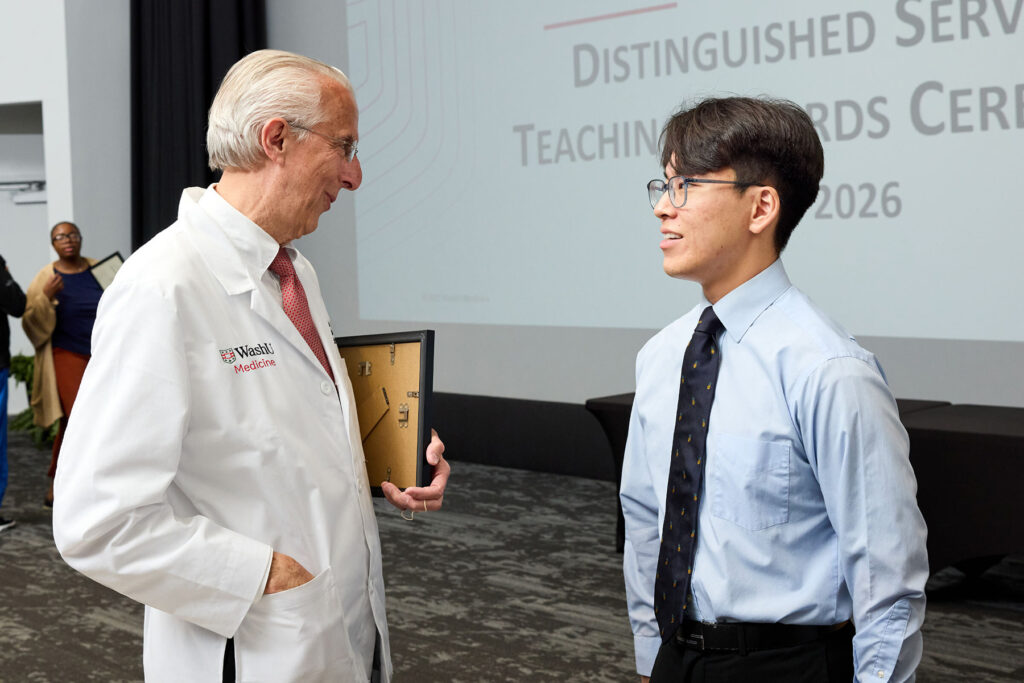
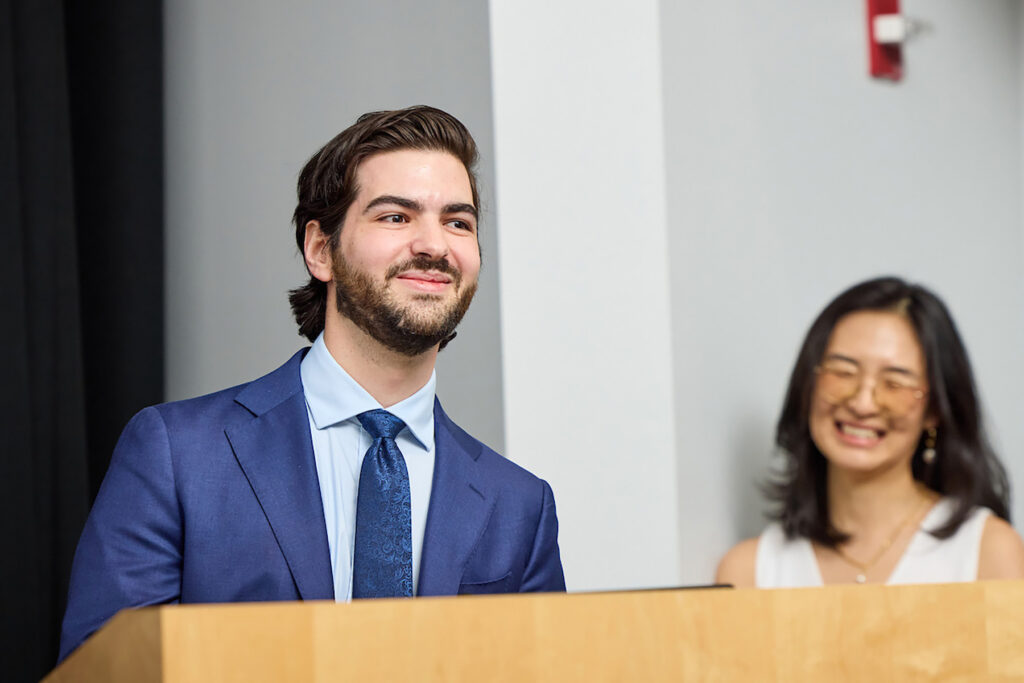
Before a crowd of WashU Medicine faculty, residents and fellow medical students, Lauren Everett shared gratitude for her mentors. “You are not only our teachers. You are architects of the next generation of physicians,” said Everett, a member of the Medical Student Government and class of 2028 class president.
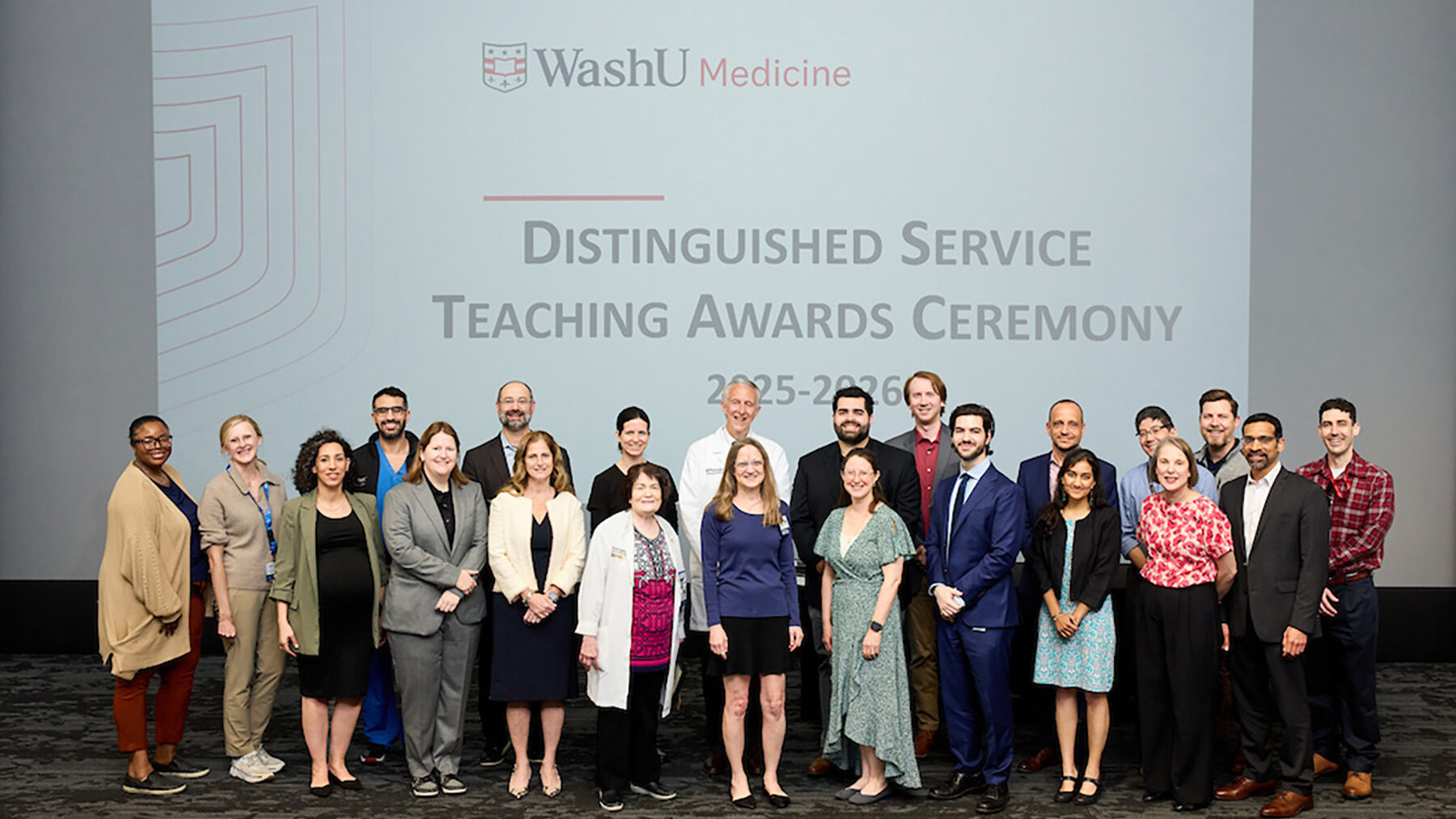
She was speaking at the annual Distinguished Service Teaching Awards ceremony, held at the Eric P. Newman Education Center on the Medical Campus. Everett and other representatives from Medical Student Government came together to show appreciation for many of their professors and resident mentors. Initiated by students and implemented with support from the Office of Medical Student Education, the honors include Phase 1, Phase 2 and the Humanism in Medicine Award. Phase 1 pertains to the pre-clinical period focused on foundational science and early clinical skills, while Phase 2 is the core clinical clerkship period where students rotate through major specialties and apply their knowledge in patient care settings.
“You help shape how we think, how we learn and how we interact with and care for others,” said Everett as she prepared to announce the Phase 1 award winners. “The knowledge you impart and the example you set extend far beyond the classroom. Truly, your influence will ripple through countless patient encounters and lives in the years to come.”
MATT MILLER/WASHU MEDICINE
Humanism in Medicine
Celebrated at the event was the students’ nominee for the Humanism in Medicine Award, which is presented annually by the Association of American Medical Colleges. The award recognizes medical school faculty physicians who exemplify the qualities of a caring and compassionate mentor in the teaching and advising of medical students.
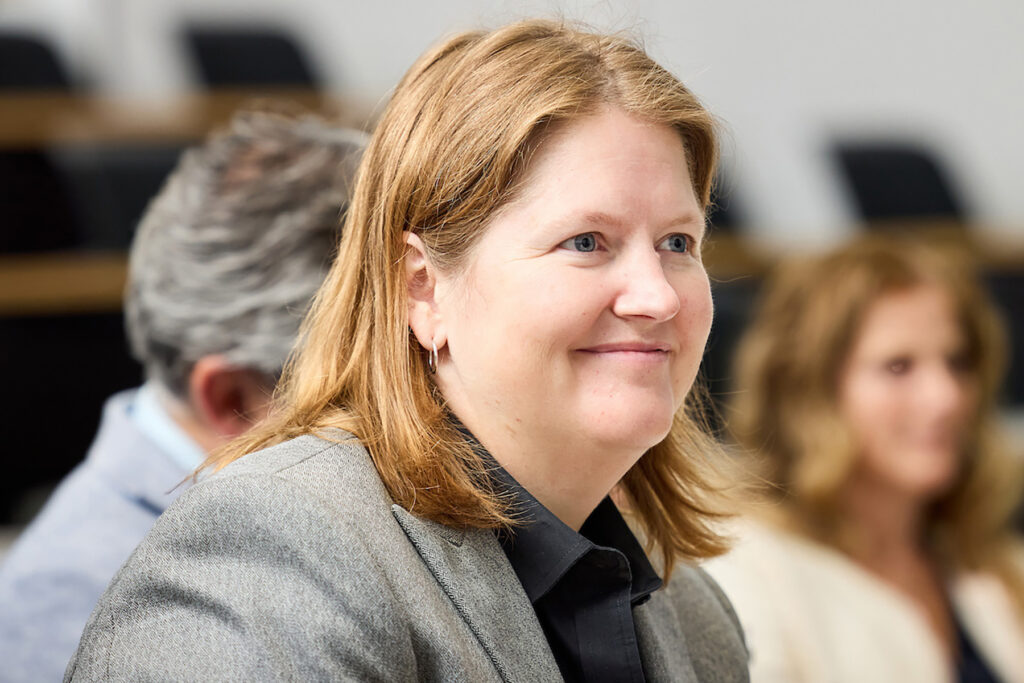
This year, the students chose Lindsay Kranker, MD, an assistant professor of surgery, to represent WashU Medicine.
MATT MILLER/WASHU MEDICINE
As an expert in trauma and surgical critical care, Kranker has dedicated her career to advocacy and mentorship, serving as the assistant director for the surgical clerkship as well as the associate program director for the general surgery residency. Through her research group, SHIELD (Strategies for Human Injury Elimination & Leveling of Disparities), she has personally guided many medical students and residents through projects that address the root causes of health disparities.
During her acceptance speech, Kranker said, “I feel like we’ve managed to find more and more capable and compassionate medical students who really get the calling of being part of medicine — not just the prestige or the intellectual inquiry — but really finding these humans who love St. Louis and who find meaning in the work that we do.”
MATT MILLER/WASHU MEDICINE
Phase 1 awards
Glenn Conroy Module Leader of the Year: Justin Sadhu, MD, professor of medicine
Jane Phillips-Conroy Professor of the Year: Steven Cheng, MD, professor of medicine
Thread Leader of the Year: Nigar Kirmani, MD, professor of medicine
Stanley Lang Teacher of the Year: Anthony Pappas, PhD, assistant professor of anatomy
Teaching Assistant of the Year: Jonathan Moran Sierra, predoctoral trainee
DSTA for Inclusion: Colleen Wallace, MD, professor of pediatrics
DSTA for Critical Thinking: Jay Malone, MD, PhD, associate professor of pediatrics
DSTA for Research: Jay Piccirillo, MD, professor of otolaryngology
DSTA for Clinical Care: Joan Noelker, MD, associate professor of emergency medicine
DSTA for Creativity: Allyson Zazulia, MD, professor of neurology and associate dean for Continuing Medical Education
DSTA for Diversity: Radhika Jain, MD, internal medicine specialist
MATT MILLER/WASHU MEDICINE
Phase 2 awards
Clerkship of the Year: Surgery
Clerkship Administrator of the Year: Alisa Cooperstein, project manager, Internal Medicine Residency Program
Clinical Educator of the Year (Attending): Salim Chahin, MD, associate professor of neurology
Clinical Educator of the Year (Resident): Jared Garland, MD, neurology resident
DSTA for Clinical Care (Attending): Basia Blachut, MD, assistant professor of obstetrics and gynecology
DSTA for Clinical Care (Resident): Michael Petrany, MD, neurology resident
DSTA for Diversity (Attending): Rita Haddad, MD, assistant professor of psychiatry
DSTA for Diversity (Resident): April Lewis, MD, obstetrics and gynecology resident
DSTA for Inclusion (Attending): David Eisenberg, MD, professor of obstetrics and gynecology
DSTA for Inclusion (Resident): Andy Habib, MD, obstetrics and gynecology resident

MATT MILLER/WASHU MEDICINE