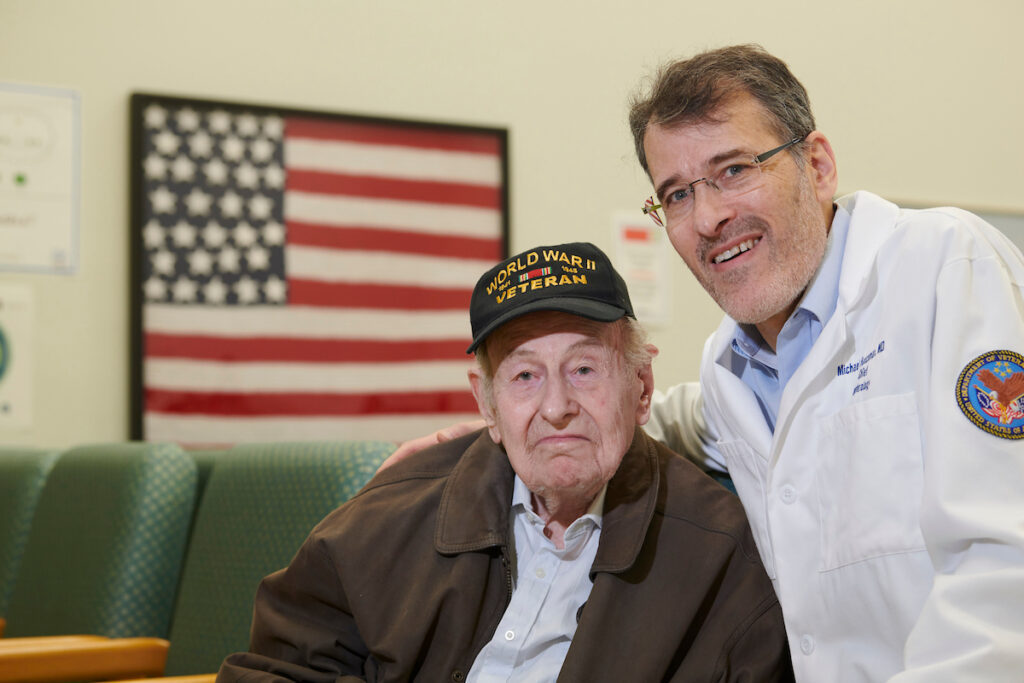
The note arrived neatly written, addressed directly to the WashU Medicine care team at VA St. Louis Health Care System.
“You have become people I trust and people I consider part of my extended family. You have been there through some of the most difficult chapters of my life, and I do not take that for granted. As a veteran, I want you to know how much it means to be treated not simply as another patient or another number, but as a person whose life, family, concerns and future matter.”
Carlos Bernal-Mizrachi, MD, has received hundreds of similar handwritten cards, emails and texts since he became chief of the Medicine Service at the VA St. Louis in 2021.
Bernal-Mizrachi came to WashU Medicine in 1999 as an endocrinology fellow, drawn by the university’s achievements in basic and translational research as well as its varied patient populations. He was recruited to lead the VA’s endocrinology section in 2016 before becoming chief of medicine. He is also the Philip E. and Carolyn E. Cryer Professor of Medicine and a professor of cell biology and physiology at WashU Medicine.
As Veterans Day approaches, Bernal-Mizrachi reflected on what this collaboration represents. The collaboration was established after World War II, when the Veterans Administration (now the U.S. Department of Veterans Affairs) turned to academic medical centers to handle the surge of returning service members. Together, the institutions have spurred clinical innovation, scientific discovery and physician training.
A partnership that delivers
Across John J. Cochran VA Hospital and VA St. Louis Medical Center-Jefferson Barracks and surrounding community clinics, the Medicine Service treats nearly 30,000 veterans each year. WashU Medicine physicians and trainees work alongside peers from Saint Louis University, distinguishing the VA as the region’s only academic medical center where both universities unite in patient care and education.
That combined effort yields high-quality care. VA St. Louis has earned a five-star rating from the Centers for Medicare & Medicaid Services for three consecutive years. The specialty care service is ranked the seventh most efficient VA in the country and leads nationally in wait times, provider capacity and reduced hospital mortality rates.
The momentum is accelerating:
- Midwest’s first VA heart transplant center: In 2027, in collaboration with WashU Medicine and Barnes-Jewish Hospital, VA St. Louis will launch a heart failure and transplant program — becoming the eighth integrated heart transplant program in the national VA system and the only one in the Midwest. The designation is out of 170 VA Hospitals.
- Advanced cardiac care: In its inaugural year, the Structural Heart Interventional Program has performed 58 complex heart procedures.
- Innovative technology: From pulse field ablations for heart arrhythmias that cut procedure times in half to noninvasive ingestible medical devices for upper gastrointestinal bleeding and a third-in-the-nation telehealth dermatology program, care delivery is constantly modernizing.
- A new horizon: A hospital tower is under construction and will transform the John Cochran campus.
A classroom unlike any other
Beyond complex procedures, the VA serves as one of WashU Medicine’s training grounds. Each year, 683 medical students, residents and fellows rotate through the VA system — with WashU Medicine trainees accounting for 41 full-time positions.
At the bedside, trainees step into a learning environment rich in history and clinical complexity. Veterans often live with age-related conditions, permanent disabilities or specific environmental exposures.
“Veterans bring questions that shape how young physicians think,” Bernal-Mizrachi explained. “Could exposure during military service be linked to diabetes? Is osteoporosis more common in all veterans, or does it depend on which war they served in? VA care adds an enriching element to our medical education program.”
In clinic exam rooms, 45-minute comprehensive visits for new patients give trainees time to listen, explain and build trust.
“Our veterans are often happy to talk to our trainees about their role in history and what they’ve accomplished, and our trainees are happy to listen,” Bernal-Mizrachi added.
From bench to bedside
The collaboration also supports WashU Medicine’s research mission. The VA’s Medicine Service, led by Bernal-Mizrachi, has 34 funded investigators with about $156 million in active grants from the VA, the National Institutes of Health (NIH) and major foundations. VA St. Louis is also the only VA facility in the country to have had three clinical senior scientists awarded for their contributions to science in the past four years.
The Bernal-Mizrachi Lab at WashU Medicine studies how vitamin D deficiency and high blood sugar affect immune cells called macrophages. These changes can cause inflammation, which may lead to high blood pressure, insulin resistance and heart disease. In mice, a lack of vitamin D before or after birth increases the risk of high blood pressure, diabetes and atherosclerosis in their offspring. Because of these findings, the team began randomized clinical trials to determine whether vitamin D supplementation during pregnancy can lower the risk of metabolic disease in children, and whether supplements in adults with type 2 diabetes can reduce blood sugar and blood pressure. This research is taking place at both the VA and WashU Medicine. The work earned Bernal-Mizrachi a VA Senior Clinician Scientist Investigator award.
One family
For Bernal-Mizrachi, the most compelling aspect of working at the VA is the culture.
“They have an enormous commitment to being a team member,” he observed of the veteran community. “Patients and medical personnel are considered one family, and they’re supposed to be treated as one family.”
He translates that ethos directly into his research lab and clinical leadership, fostering teams built on shared accountability and mutual support.
In June 2025, the secretary of Veterans Affairs presented Bernal-Mizrachi with a personalized VA challenge coin — a rare honor for a civilian. Though he has not served in the military, the token remains one of his most cherished possessions.
“Veterans usually give them to one another,” he said. “It’s a beautiful honor to receive one.”