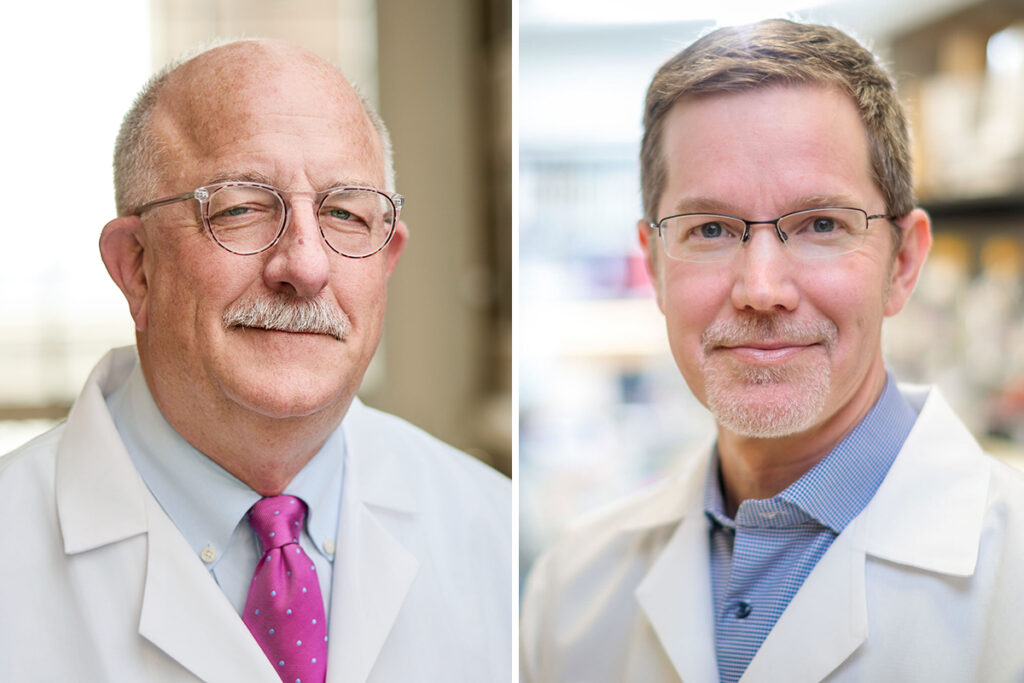
Since 1953, when WashU commemorated its first 100 years, the university has celebrated Founders Day, an opportunity to recognize faculty, alumni and friends. This year, two WashU Medicine faculty members are among those honored.
Distinguished Faculty Award
Paul J. Scheel Jr., MD, received a Founders Day Distinguished Faculty Award. He serves as vice chancellor for clinical affairs at WashU Medicine, chief executive officer of WashU Medicine Physicians, president of the WashU Medicine/BJC HealthCare Physician Provider Organization and professor of medicine in the Division of Nephrology.
Scheel is an internationally recognized expert in nephrology and a thought leader at the intersection of clinical excellence, academic medicine and health system leadership. As CEO of WashU Medicine Physicians, he oversees one of the nation’s largest academic group practices, working closely with leaders across the medical school and BJC HealthCare to align physicians in delivering patient-centered care.
Scheel plays a critical role in the 45-year affiliation agreement between WashU Medicine and BJC HealthCare. He oversees the operations, strategy and growth of more than 3,800 clinical providers across more than 200 clinic locations and health facilities, including Barnes-Jewish Hospital and St. Louis Children’s Hospital. Since joining the university in 2017, he has overseen growth in the total number of patients, faculty and care sites for WashU Medicine and BJC HealthCare, as well as their joint annual clinical services revenue.
In less than a decade with Scheel at the helm, WashU Medicine Physicians increased the total number of patients seen annually by more than 372,500, with total faculty also growing by nearly 850 individuals. Meanwhile, joint clinical services revenue increased by more than $1.78 billion, while the St. Louis region gained more than 80 new locations for clinical care, including the Gary C. Werths Building at Siteman Cancer Center, the Plaza West Tower at Barnes-Jewish Hospital and new satellite clinics.
These achievements reflect Scheel’s collaboration with stakeholders across the university, including department chairs, deans, BJC HealthCare leadership and the business operations teams of WashU Medicine and the university. As he has advanced recruitment, expanded services, improved the patient and provider experience, and enhanced quality and safety, WashU has also gained stature as the fastest growing research institution in the country as measured by funding from the National Institutes of Health (NIH).
Scheel joined WashU Medicine in 2017 from Johns Hopkins Medicine, where he was vice president of the Office of Johns Hopkins Physicians, leading multidisciplinary teams to improve quality, efficiency and the patient experience across that university health system. At the same time, he directed the school’s Division of Nephrology as the Ronald Peterson Professor of Medicine. Additionally, he led the Baltimore-based Integrated Renal Solutions of Johns Hopkins HealthCare as that entity’s medical director. During his time at Hopkins, Scheel developed a medical therapy for retroperitoneal fibrosis, a rare kidney disorder. The treatment eliminates the need for surgery and the insertion of ureteral stents. He has also contributed to consensus guidelines for managing other complex kidney conditions.
Scheel is board-certified in internal medicine and nephrology and has authored numerous peer-reviewed publications. He earned his bachelor’s degree from the University of Lynchburg in Virginia and his medical degree from Georgetown University School of Medicine. He also earned a master’s degree in business administration from Johns Hopkins, where he completed his residency in internal medicine and a fellowship in nephrology.
Carl and Gerty Cori Faculty Achievement Award
Timothy M. Miller, MD, PhD, received the Founders Day Carl and Gerty Cori Faculty Achievement Award. Miller is the David Clayson Professor of Neurology, co-director of the ALS Center and vice chair of research in the Department of Neurology.
Miller studies the treatment of neurodegenerative diseases by targeting their genetic causes. His work on amyotrophic lateral sclerosis (ALS), a progressive disease that destroys nerve cells controlling movement, has shown that silencing a disease-causing gene can slow the course of some inherited forms. That finding is giving patients and clinicians new hope for conditions that have long resisted treatment.
Miller joined WashU Medicine in 2007 following postdoctoral training at the University of California San Diego (UCSD), where he studied disease models of ALS as part of UCSD’s Clinical Scientist Training Program. At WashU Medicine, Miller provides expert clinical care, leads a translational research program and directs clinical trials to test new therapeutic approaches.
For decades, the standard treatment for ALS was managing symptoms — not changing the course of the disease. Miller fundamentally shifted that paradigm by pioneering an approach to silencing the genes responsible for certain genetic forms of the illness. His team’s research led to the development of tofersen, a drug designed to target and lower the levels of a toxic protein that causes nerve-cell death in patients with a specific genetic subtype of ALS. This approach — using genetic medicines to target the root cause of neurodegeneration — provides a roadmap that Miller and other researchers are now applying to explore treatments for other complex illnesses, including nongenetic ALS, Parkinson’s disease, Alzheimer’s disease and others.
Miller has received numerous awards and honors for his scholarship. In 2026, he received the Potamkin Prize, and in 2023 he was awarded the Rainwater Prize for Outstanding Innovation in Neurodegenerative Disease Research. Also in 2023, Miller was elected to the National Academy of Medicine, one of the highest honors in the fields of health and medicine in the United States. Other awards include the 2018 Sheila Essey Award for ALS Research and the inaugural 2020 Healey Center International Prize for Innovation in ALS.
Miller is a member of the Network of Excellence for ALS, serving on the executive committee and as co-chair of the scientific advisory board. He is also a member of the American Academy of Neurology, the American Neurological Association, the Society for Neuroscience, the American Society for Clinical Investigation and the Association of American Physicians.
A St. Louis native, he earned his MD and PhD at WashU Medicine, followed by a residency at the University of California, San Francisco, where he served as chief resident in his final year and completed a neuromuscular fellowship under the mentorship of an ALS expert.
Learn more about Founders Day and other honorees here.