For most of the faculty and staff who move across WashU Medicine’s Medical Campus every day — and our patients and visitors — wayfinding is invisible until it isn’t. “Wayfinding” refers to a system created to help us orient ourselves and navigate through space. When it works, we find the right clinic, the right lab, the right elevator bank without trouble. When it doesn’t, an anxious patient is late to chemotherapy, a researcher is stuck in limbo instead of connecting with collaborators, or a resident misses an important mentoring opportunity.
That quiet, everyday choreography traces back in part to Bob Henkel. As the inaugural program manager for signage in Enterprise Physical Operations at WashU Medicine, Henkel oversees sign projects across the 65-plus buildings the department maintains on the Medical Campus. BJC HealthCare manages signage in its own buildings, including Barnes-Jewish and St. Louis Children’s hospitals, as well as the wayfinding along the Link, and the two organizations coordinate closely so people moving between them encounter the same look and feel. Henkel’s piece of that work is essentially translation: taking the sprawl of a busy academic medical center and turning it into something a newcomer can navigate, even on a stressful day.
A connecting thread of collaboration and service
Henkel joined WashU Medicine in 2023, continuing a career path that was largely oriented around service to others and the community. Before signage, he worked in outdoor and environmental education, led wilderness trips for young people and seniors and, for nearly a decade, ran sustainability programming and recycling operations for events across St. Louis with the nonprofit earthday365.
To Henkel, that seemingly disparate series of roles shared an underlying constant: working closely with others to solve problems, an approach to work he traces back, half-jokingly, to being the third sibling of four growing up in upstate New York and “constantly having to work with others to get your needs met.” He was drawn to WashU Medicine by the opportunity to work with “an outstanding group of people” on an internal signage program, including a joint WashU/BJC signage, branding and wayfinding committee. The program took shape after the BJC Planning, Design & Construction’s Sign Shop, which had long produced and maintained signage across campus, shifted its focus to managing signage in BJC-owned and -managed buildings and in shared public spaces.
“It’s always been kind of a team-in-the-trenches feeling,” Henkel said of his work roles. “Things like summer camps and outdoor wilderness adventures, where you’re out in the field, can be intense. You have to be a problem solver in the moment.”
Henkel spent his first six months learning the campus on foot — how to get from one building, garage and elevator bank to the next. After three years, he still puts about 5 miles on his shoes on a typical workday — “5.8 today,” he noted during a recent walkthrough of the campus — and has worn through several pairs since he started.
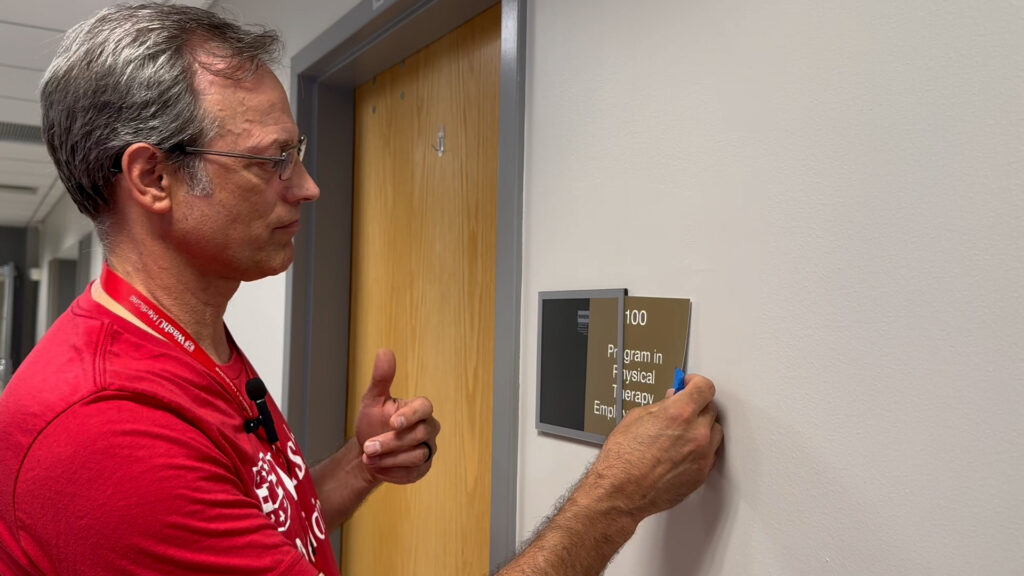
At WashU Medicine, Henkel’s problem-solving focus shapes an approach to signage geared toward hierarchy over abundance. Put up too many signs and people stop reading, so the signage program Henkel inherited and continues to develop favors the simplest possible solution: an arrow, a room number or a concise directory, rather than a surplus of details.
There’s a business case for such simplicity, too: “Sometimes people want to make a whole lot of updates to signs — they want to get their name, their department, their lab on everything,” Henkel said. “That makes it hard for us to maintain. Over time, we’d have to spend a lot more dollars to change those out every time a person or department moves. And we really want those dollars to go toward research funding, toward our students and toward our clinical practice mission.”
In other words: Dollars saved on signage are dollars available for the work that defines WashU Medicine. That thinking shows up in ways most of us have never had reason to notice.
Hiding in plain sight
Take the Link, the corridor many of us walk every day. If you look down, you’ll see a band of yellow woven into the carpet running from hospital to hospital. That’s not simply a decorative flourish. The yellow band throughout the Link was developed by BJC to assist with wayfinding for its patients. Henkel coordinates with BJC to maintain consistency with this established marker, matching the yellow Link icon to the carpet and giving anyone using the Link a literal yellow road to follow — an elegant piece of cross-team collaboration hiding in plain sight.
One of the things I really appreciate about this work is that you can’t always just take a request at face value. You have to ask questions to get at what problem needs solving and what creative solutions — not necessarily something entirely new — might be doable.
Bob Henkel, WashU Medicine
Or consider the nameplates outside offices and labs across campus. Look closely, and you’ll notice a slim paper insert slotted into each one with basic information about the room and its function or occupant. Henkel’s supervisor, Hannah Jefferies, senior director of interiors and relocation space planning at WashU Medicine, developed a program with FedEx to produce these inserts for about $10 each, replacing an older process that cost several times more and took weeks to complete. When the room’s use changes, an administrator can pop the old insert out with a sticky note or piece of painter’s tape, like the one Henkel carries in his pocket for exactly this purpose, and slide a new one in. Though the savings are small on any single sign, those dollars add up over the years, keeping more money available for research, education and patient care.
When it comes to the signs themselves, there are some firm guidelines Henkel follows. For example, nameplates should include graduate-level credentials only, and no more than three. (He has seen as many as six listed after a name and in the tiniest of fonts.) A building directory typically lists conference rooms, restrooms, principal investigators and their labs — not every tissue culture or microscopy room. Taped-up paper signs are off-limits by policy. In some patient-facing areas, signs list only a job title rather than a person’s name, so nothing needs replacing when staff change.
Finding creative solutions
Some challenges Henkel encounters turn out not to be signage problems at all. A campus institute connected with him after submitting a project request for a new stone monument sign in its parking lot to make it easier for visitors to locate the building. Such signs typically run $50,000 to $75,000 — over their budget of $25,000. Henkel walked the site to figure out how to bridge the gap and discovered the institute’s name was already on the lower part of an existing stone monument at the front entrance — but had been obscured by overgrown vegetation from an adjacent donor garden. He called WashU Medicine’s landscape manager, who agreed that some trimming would restore the monument’s visibility. The institute got the wayfinding it needed without having to pay for new signage.
“One of the things I really appreciate about this work,” Henkel said, “is that you can’t always just take a request at face value. You have to ask questions to get at what problem needs solving and what creative solutions — not necessarily something entirely new — might be doable.”
A key part of his skill set is a willingness to zoom out — to step back from the request as presented and look at the whole space from a different perspective. In the case of the stone sign, that zooming out saved thousands of dollars and preserved the donor garden’s beauty.
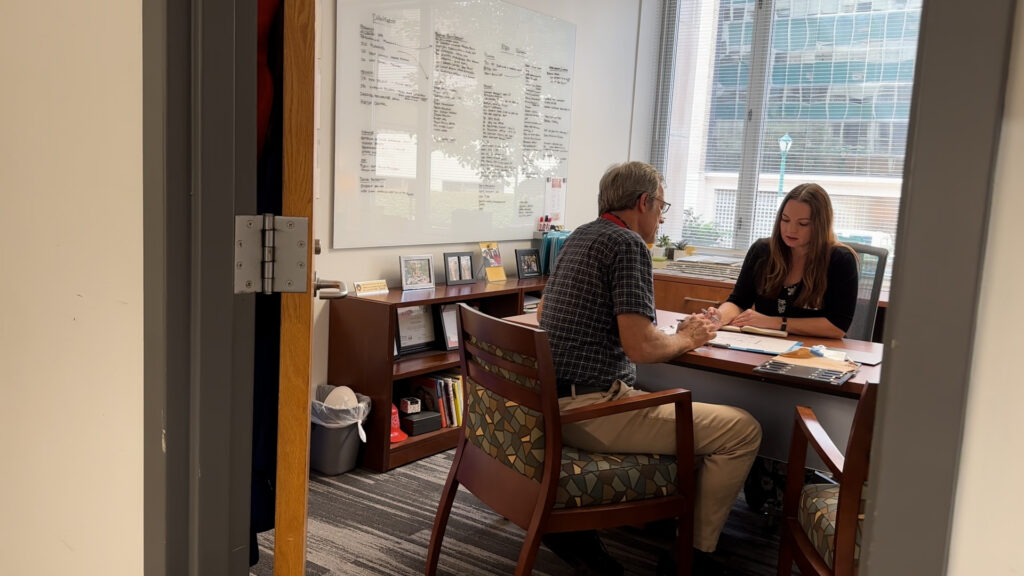
Such solutions are rarely reached alone. Henkel is quick to name the colleagues across the Medical Campus and beyond with whom he regularly collaborates, including Jefferies; Beth Anglin, associate director of brand management in the Office of Marketing and Communications; and Lizz Gunn, senior associate director of donor recognition in University Advancement.
“Bob thinks about the building the way a patient or visitor experiences it, not the way it looks on a floor plan,” Jefferies said. “He doesn’t treat signage as something you bolt onto a space at the end. He’s at the table early, asking how people will actually move through a space, and the campus is easier to navigate because of it.”
“And he’s generous with his time,” she added. “If someone on our team needs a second set of eyes on a wall or a corridor, he’s already walking over.”
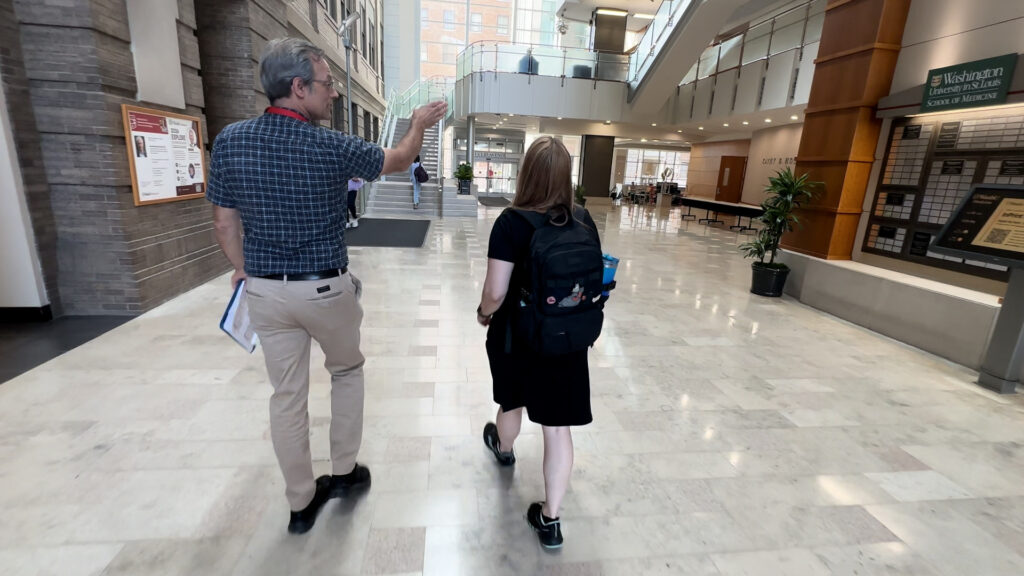
Henkel would be the first to tell you that WashU Medicine’s signage program, while designed to make wayfinding on the Medical Campus seamless, shouldn’t discourage a person from asking others to help them find their way when needed — or to lend a hand to someone else navigating our complex, interconnected set of spaces. Even the most comprehensive signs don’t replace human-to-human interaction, he emphasized.
“I don’t think it’s ever a bad thing for us to stop and help a person find their way around the campus,” Henkel said. “Stop your work, go for a walk with a stranger and you learn new things.”