
At WashU Medicine, leadership is central to everything we do. Our physicians lead teams that deliver exceptional patient care, our scientists direct groundbreaking research and our educators shape the next generation of leaders in medicine and biomedical science. To sustain this excellence, it’s essential that our leaders are not only experts in their fields but also have highly effective leadership and management skills.
The Pivotal Leaders Program plays a critical role in this effort. The program was designed to help division directors and section chiefs meet their leadership and management challenges. By investing in our leaders, we’re investing in the future of WashU Medicine and the people we serve — because the impact of a strong leader extends far beyond a single individual.
When leaders develop the skills to build trust, communicate effectively and create a positive culture, their influence can ripple across an organization. Their teams are better positioned to thrive, faculty and staff feel supported and engaged, learners benefit and future leaders have opportunities to develop their skills.
Renée Shellhaas, MD, the David T. Blasingame Professor of Neurology and senior associate dean for faculty promotions and career development at WashU Medicine, developed and launched the program in 2024.
“What I love most about the Pivotal Leaders Program is how it ripples outward, leaving a profound mark on the faculty, learners and staff members the participants lead,” Shellhaas said. “In the two years since its inception, we’ve witnessed a direct impact on the quality of faculty careers, learner experiences, operational efficiencies and the overall climate and culture of our Pivotal Leaders’ clinical and academic environments.”
The 2025-26 cohort included representatives from 13 departments and programs. During monthly in-person sessions, participants explored topics such as financial management, mentorship, inclusive leadership, and how to enhance trust, psychological safety and communication within their departments. The goal is for each leader to not only build and strengthen their own skills, but apply their newfound confidence and capabilities to inspire their entire teams to function at the top of their specific fields, across all WashU Medicine mission areas.
“This is the first program of its kind that I’ve been a part of here or at my previous institution. The fact that WashU Medicine offers it tells me they’re genuinely invested in growing their leaders and improving overall culture.”
Joanna Yang, MD, MPH
Now in its third year, the nine-month Pivotal Leaders Program brings together division directors and section chiefs from across WashU Medicine to develop key leadership and management skills. The program is tailored to the participants’ roles and is designed to be hands-on and practical, so they can confidently apply what they learn to strengthen their teams and, by extension, the entire medical school.
Forty-eight division and section leaders took part in the program’s first two cohorts. The new 2026-2027 Pivotal Leaders cohort, which launched Sept. 9, includes 24 additional leaders drawn from 12 programs and departments.
“Leadership in academic medicine doesn’t develop by accident, but it is crucial to the success of our organization,” Shellhaas said. “At WashU Medicine, we prioritize development of these faculty through deliberate and strategic investment in gold standard, customized programs that teach critical management and leadership skills our participants can put into practice immediately.”
For Joanna Yang, MD, MPH, the program offered an opportunity to develop as a leader while learning alongside colleagues who face many of the same challenges. Yang is chief of the leukemia and lymphoma service, an associate professor of radiation oncology, vice chair of education and director of the Clinical Residency Program in the Department of Radiation Oncology. “This is the first program of its kind that I’ve been a part of here or at my previous institution,” she said. “The fact that WashU Medicine offers it tells me they’re genuinely invested in growing their leaders and improving overall culture.”

MATT MILLER / WASHU MEDICINE
One session that particularly resonated with Yang focused on the “coachability equation” and was led by John Schneider, MD, WashU Medicine’s inaugural assistant dean for faculty coaching — himself a member of the inaugural Pivotal Leaders Program. The session focused on what makes a person coachable and what characteristics create the conditions for personal and team growth. Pivotal Leaders walked through strategies to enhance their personal coachability as a catalyst to build coaching cultures within and across their divisions and sections. Yang has since shared the concept with her entire department — peers and trainees alike.
Over the program’s nine months, participants also heard from speakers and worked with facilitators from both within and outside of WashU Medicine; took part in six hours of 1:1 executive coaching sessions; and received a 360-degree evaluation that incorporated feedback from department heads, peers and direct reports to build a fuller picture of strengths and growth areas.
72
division directors and section chiefs have participated in the Pivotal Leaders Program
“For many of our participants, engaging with their executive coach was transformative,” Shellhaas said. “They worked through their 360 results and developed growth plans to address areas of relative weakness, set clear and actionable goals and pinpoint specific actions to improve their effectiveness as pivotal leaders.”
For Gregory Holtzman, PT, DPT, a professor of physical therapy and of orthopedic surgery and Pivotal Leader alumnus, the program supplied the impetus — and the skills — to implement changes in how he leads the physical therapy clinical practice division.
“It was invaluable to discuss challenges and swap ideas for improvement with leaders who were in the same boat as me,” Holtzman said. “The program inspired me to be more intentional about succession planning and cultivating future leaders.”
For example, based on his Pivotal Leaders experience, Holtzman sought input from his team members about their interests and encouraged them to participate in task forces and committees that aligned with team priorities and individual career goals. He also established a mid-year check-in process to create another opportunity for clinical providers in his division to feel supported and heard.
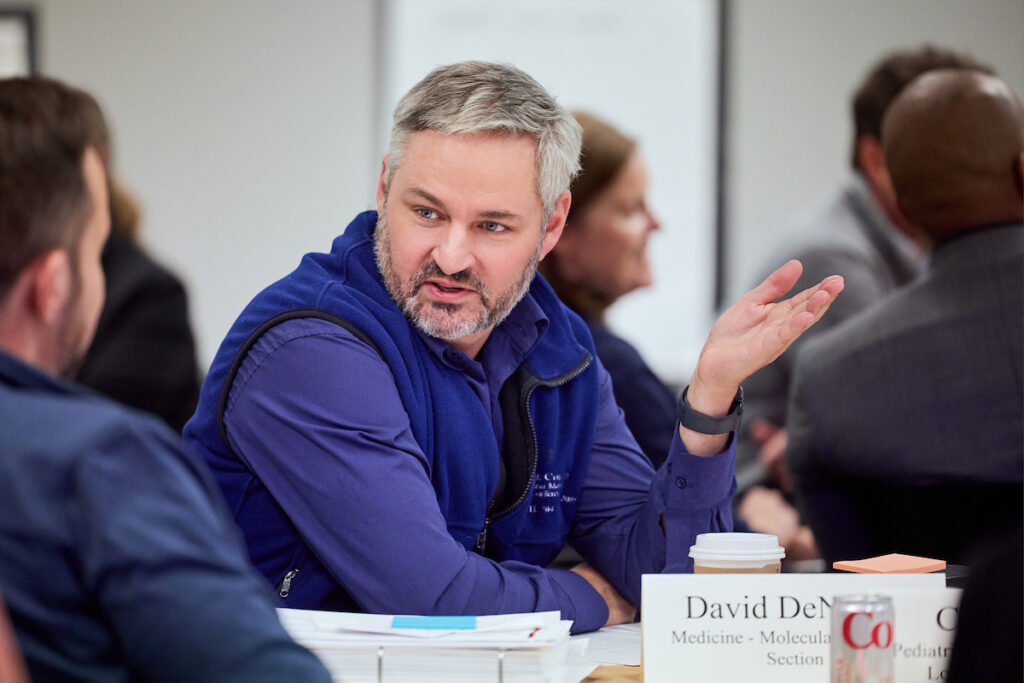
MATT MILLER / WASHU MEDICINE
Graduates of the program go back to their departments “better equipped to lead the teams that make academic medicine possible,” Shellhaas said. “The bonds that they form with other leaders in their cohort are strong and enduring, which creates a community of engaged and skillful leaders.”
Learn more about the Pivotal Leaders Program and explore other professional development programming available through the Office of Faculty Promotions & Career Development.