WashU Medicine has been selected as one of 11 multi-institutional teams participating in an American Medical Association initiative to make medical education more individualized, data-informed and responsive to student needs. The project received a $1.1 million grant earlier this year and reflects the school’s continued leadership in academic medicine.
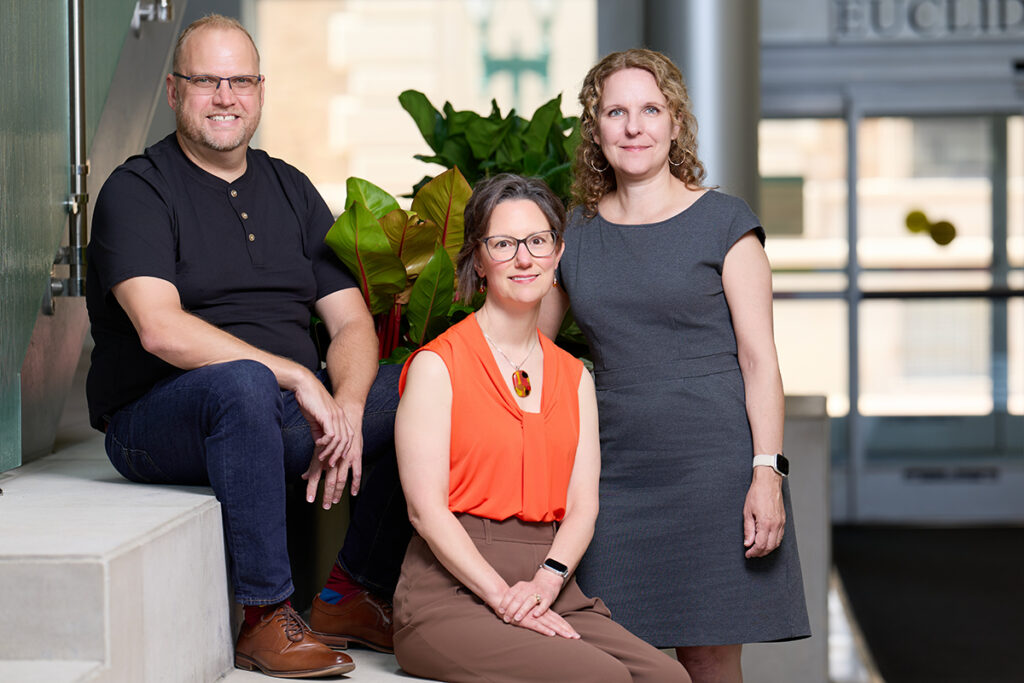
The WashU Medicine faculty leading the effort are:
- Amanda R. Emke, MD, MHPE, professor of pediatrics in the Edward Mallinckrodt Department of Pediatrics and assistant dean for student assessment in the Office of Education
- Carolyn Dufault, PhD, associate professor of medicine in the John T. Milliken Department of Medicine and associate dean for educational digital transformation and data strategy in the Office of Education
- Adam T. M. Wyatt, PhD, associate professor of pediatrics and core scholarship faculty in the Office of Education
Their work focuses on improving how medical schools prepare students for residency by using data analytics to better connect performance in medical school with residency outcomes.
The effort is grounded in the idea of precision education: just as precision medicine tailors care to individual patients, precision education aims to tailor instruction, coaching and support to individual learners. At WashU Medicine, that work is already underway through personalized coaching and dashboards that track student progress across key competencies, including medical knowledge, patient care, interpersonal and communication skills, professionalism, systems-based practice, and practice-based learning and improvement.
This new grant expands that work by bringing together data from 15 collaborating institutions. With a larger and more diverse data set, the team hopes to identify patterns that may not be visible at a single institution.
“The power of this is really going to be data at a scale that lets us see patterns that you couldn’t see from a single institution alone,” Dufault said. “We now have enough data that we can pool together and look for the patterns for things we might target.”
Emke, Dufault and Wyatt are working toward a system that combines medical school performance data with residency outcomes, including information gathered after students begin residency training.
“This is about thinking at the individual level about a student’s strengths, the areas where they need targeted improvement and their goals for life and the future,” Emke said.
Over time, this longitudinal approach could help support AI-enabled coaching tools that guide students toward the skills, experiences and performance patterns that may be most helpful for success in a chosen specialty.
“This is about thinking at the individual level about a student’s strengths, the areas where they need targeted improvement and their goals for life and the future,” Emke said. “We already are doing precision education for our students through this work. By joining this consortium, we add more power to help a student’s performance with anticipation of what their future career will look like.”
The grant is part of the American Medical Association’s Transforming Lifelong Learning Through Precision Education Grant Program, a $12 million investment supporting 11 projects across more than 80 institutions.
“We’ve been really at the forefront of precision education through our implementation of a competency-based program, but in a very forward-thinking way,” Emke said. “Most schools are talking about competency-based education at the medical student level, but this is different because we’re doing it across all four years, and aligning it with the key knowledge, skills, behaviors and attitudes every medical student needs to be a successful resident starting on day one.”